MM TAX CLUB_whatsapp

MM TAX CLUB

Accounting & Tax Consultancy Firm

Blogs

Important Update: Income Tax Department enables “Discard ITR” Option for Unverified Original/Belated/Revised ITRs Starting from AY 2023-24

Question 1:
I filed my Original ITR u/s 139(1) on 30th July 2023 but not yet verified. Can I Discard it?

Response:
Yes, user can avail the option of “Discard” for the ITRs being filed u/s 139(1) /139(4) / 139(5) if they do
not want to verify it. User is provided a facility to file an ITR afresh after discarding the previous 
unverified ITR. However, if the “ITR filed u/s 139(1)” is Discarded and the subsequent return is filed after 
the due date u/s 139(1), it would attract implications of belated return like 234F etc., Thus, it is advised to 
check whether the due date for filing the return u/s 139(1) is available or not before discarding any 
previously filed return.

Question 2:
I Discard my ITR by-mistake. Is it possible to reverse it?

Response:
No, if ITR is Discarded once, it can’t be reversed. Please be vigilant while availing Discarding option. If an 
ITR is Discarded, it means that, such ITR is not filed at all.

Question 3:
Where can I find “Discard option” ?

Response:
User can find Discard option in below path : 
www.incometax.gov.in → Login → e-File → Income Tax Return → e-Verify ITR → “Discard”

Question 4:
Is it mandatory to file subsequent ITR if I “Discarded” my previous unverified ITR ?

Response:


Advisory for the procedures and provisions related to the amnesty for taxpayers who missed the appeal filing deadline for the orders passed on or before March 31, 2023

1.   Amnesty for Taxpayers: The GST Council, in its 52nd meeting, recommended granting amnesty to taxpayers who could not file an appeal under section 107 of the CGST (Central Goods and Services Tax) Act, 2017, against the demand order under section 73 or 74 of the CGST Act, 2017, passed on or before March 31, 2023, or whose appeal against the said order was rejected due to not being filed within the specified time frame in sub-section (1) of section 107.

2.   In compliance with the above GST Council recommendation, the government has issued Notification No. 53/2023 on November 2, 2023.

3.   Taxpayers can now file an appeal in FORM GST APL-01 on the GST portal on or before January 31, 2024, for the order passed by the proper officer on or before March 31, 2023. It is further advised that the taxpayers should make payments for entertaining the appeal by the Appellate officer as per the provisions of Notification No. 53/2023. The GST Portal allows taxpayers to choose the mode of payment (electronic Credit/Cash ledger), and it is the responsibility of the taxpayer to select the appropriate ledgers and make the correct payments. Further, the office of the Appellate Authority shall check the correctness of the payment before entertaining the appeal and any appeal filed without proper payment may be dealt with as per the legal provisions.

4.   If a taxpayer has already filed an appeal and wants it to be covered by the benefit of the amnesty scheme would need to make differential payments to comply with Notification No. 53/2023. The payment should be made against the demand order using the "Payment towards demand" facility available on the GST portal. The navigation step for making this payment is provided: Login >> Services >> Ledgers >> Payment towards Demand.

5.   Taxpayers who have previously filed an appeal but it was rejected as time barred in APL-02 by the Appellate authority, then the taxpayer would be able to refile the appeal. However, in case, the taxpayers face any issue while re-filing APL-01, a ticket shall be raised on the Grievance redressal portal: https://selfservice.gstsystem.in. The taxpayer shall select the Category “Amnesty Scheme” and the sub-category “Amnesty scheme- Issue in appeal filing” while raising a ticket.

6.   Furthermore, if the Appellate authority has issued a rejection order in APL-04 due to the appeal application being time-barred, then the taxpayer has to approach the respective Appellate authority office well in advance to comply with the dates in the said notification. The Appellate authority after checking the eligibility of the taxpayer for the amnesty scheme will forward the case to GSTN through the State Nodal officer.

7.   Also, it is important to note that for the APL 04 issued cases no direct representations will be entertained by GSTN or through the Grievance redressal portal. APL 04-issued cases have to be compulsorily forwarded through the State Nodal officer.

8.   Post receiving the case from the State nodal officer, GSTN will enable the taxpayer to file an appeal against the concerned order.

 
  • Source

Ministry of Finance, hosts APG Annual Typologies Workshop in association with Asia Pacific Group on Money Laundering (APG) and the World Bank

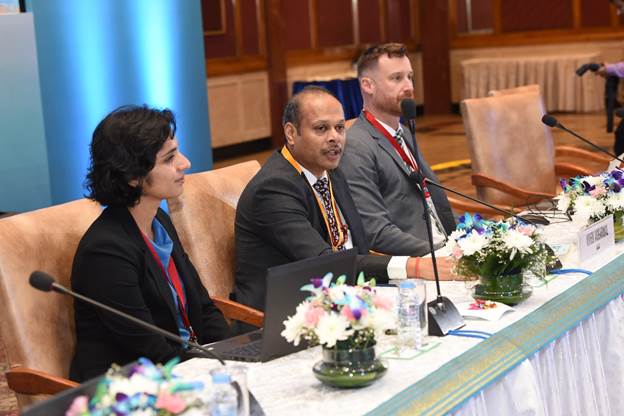
The Department of Revenue, Ministry of Finance, is hosting the APG Annual Typologies Workshop in association with Asia Pacific Group on Money Laundering (APG) and the World Bank from 28th November to 1st December, 2023 in New Delhi.

Yearly typologies workshops are held by the APG to bring together experts and APG delegates to discuss money laundering and terrorist financing trends as well as policy issues emerging from those trends. These workshops have topical 'themes' to provide a focus for the discussion. Twenty-three typologies workshops have been held since the APG's formation in 1997. After 2018, this is the first in-person workshop.  A total of 26 jurisdictions are participating in the workshop.

The workshop began with a welcome address by Shri Vivek Aggarwal, Additional Secretary (Department of Revenue) and Head of the Indian Delegation to Financial Action Task Force (FATF), followed by adoption of yearly typologies report on money laundering (ML), terrorism financing (TF), and proliferation financing (PF) trends. The report features a focus section on virtual assets and virtual asset service providers, in recognition of the threat they pose for ML, TF, and PF.


Further, the workshop is divided into three broad streams - Virtual Assets (VA), Illegal Fishing, and Tax Crimes. World Bank is delivering an ML/Tax Crimes Training Exercise and will cover various facets – ‘whole-of-government’ approach in taxing crime, various sources of information, beneficial ownership, tax crimes as predicate offence, international cooperation, organisation of evidence and typologies

The Virtual Assets/Virtual Assets Service Providers Stream will be focusing on the risk assessment, private sector perspective through VASPs participation, terrorism financing and proliferation financing through VA, law enforcement case studies, etc.


The illicit financial flows from illegal fishing pose a complex challenge for law enforcement.  A lack of understanding of the transnational nature of this crime; weak international coordination on illegal proceeds of illegal fishing; and absence of parallel financial investigations, result in negligence ML or parallel financial investigations on this predicate offence. The APG adopted an Issues Paper on illegal fishing which will form the basis of discussions during the workshop.

APG is one of the Financial Action Task Force-Style Regional Bodies (FSRBs) and is the largest with 42 members in terms of membership numbers and geographical size. The APG also has a large number of observers (both jurisdictions and supporting organisations) that participate in its programmes and activities. Some of the key international organisations that support the APG include the International Monetary Fund, World Bank, OECD, United Nations Office on Drugs and Crime, the UN's Counter Terrorism Executive Directorate, Asian Development Bank, Commonwealth Secretariat, INTERPOL and the Egmont Group of Financial Intelligence Units.

DFS Secretary chairs meeting on Cyber Security in Financial Services Sector and Online Financial Frauds

The Secretary, Department of Financial Services (DFS), Ministry of Finance, chaired a meeting in New Delhi, today, to discuss issues related to cyber security in the financial services sector and increasing incidents of recent online financial frauds.

The meeting was also attended by Secretary, Telecom and senior officials of Department of Financial Services (DFS), Department of Economic Affairs (DEA), Department of Revenue (DoR), Ministry of Electronics & Information Technology (MeitY), Department of Telecom (DoT), Reserve Bank of India (RBI), Telecom Regulatory Authority of India (TRAI), Unique Identification Authority of India (UIDAI), Indian Cyber Crime Co-ordination Center (I4C), National Payments Corporation of India (NPCI), State Bank of India (SBI), Bank of Baroda,  Canara Bank, Punjab National Bank, HDFC Bank, ICICI Bank, IDFC First Bank, Airtel Payment Bank, Equitas Small Finance Bank, Google Pay India, PayTM, and Razorpay.

The Indian Cyber Crime Co-ordination Center (I4C), Ministry of Home Affairs, made a presentation on the latest statistics of digital payment frauds as reported in the National Cyber Crime Reporting Portal (NCRP), various sources of these financial frauds, modus operandi adopted by the fraudsters, including challenges faced to counter financial cybercrimes. Further, representatives from State Bank of India (SBI) made a brief presentation on the Proactive Risk Monitoring (PRM) strategy implemented by SBI. Besides, PayTM and Razorpay representatives also shared their best practices which has enabled them to mitigate such frauds.

The meeting took stock of the preparedness of the banks and other financial institutions in tackling the challenges arising from cyber security in the financial services sector, increasing trend of digital payment frauds, and deliberated on a focused approach to mitigate such cyber-attacks and frauds. It was noted during the deliberation that:


  • 70 lakh mobile connections involved in cybercrime/ financial frauds reported through digital intelligence platforms have been disconnected so far.
  • Rs. 900 crore defrauded money has been saved, benefitting 3.5 lakh victims


Some of the issues that were discussed included:


  • Renewed focus on facilitating seamless coordination between Police, Banks and Financial Entities for real time tracking and blocking of defrauded money
  • Bringing all financial institutions including NBFCs and major cooperative banks on ‘Citizen Financial Cyber Fraud Reporting and Management System (CFCFRMS)’ platform, wherein 259 financial intermediaries are already onboarded
  • Strategy to tackle menace of mule accounts by banks
  • Banks to improve the response time in handling the alerts on online financial frauds received from different agencies
  • Appointment of regional/ state level nodal officers by the banks and financial institutions to cater to the requirements of law enforcement agencies
  • Maintaining a central registry of onboarding of merchants and standardisation of KYC
  • Whitelisting of digital lending apps through consultation with relevant stakeholders
  • Status on implementation of recommendations of the Digital Lending Working Group including setting up of Digital India Trust Agency (DIGITA) and bringing a new legislation ‘Banning of Unregulated Lending Activities (BULA) Act’
  • All stakeholders including banks and financial institutions to undertake more customer awareness and sensitisation programmes on digital payments security

Source

Consequences of late filing and incorrect filing GST annual Return GSTR-9

Time to time CBIC tightens and rationalises the GST compliance law for the taxpayers. Non compliances with the GST law can leads to many consequences and litigation with GST Department.

Before proceeding to the consequences of late filing or incorrect filing of GST Annual Return, we know the details about GSTR-9.

GSTR-9 is a consolidated GST Return of every month or quarter of a particular year, it’s require to be file by the every registered person under GST. However GSTN has provided relief to the small business since beginning of the GST era (F.Y 2017-18). Filing of GSTR-9 annual return is optional for the registered dealer whose aggregate annual turnover does not exceed Rs.2 crore.

Along with GSTR-9, a reconciliation statement require to be file by a taxpayer whose aggregate annual turnover exceeds Rs.5 crore.

As per Section 44 of the CGST and SGST Act 2017, an annual return shall be duly filed by a taxpayer on or before 31st of December of the next financial year.

For FY 2022-23 due dates for filing GSTR-9 annual return is 31st December 2023. There are separate annual return forms for the composition dealer and E-commerce operator, GSTR-9A and GSTR-9B respectively.

There is per day late fees penalty for delay in filing GST annual return with a maximum amount of prescribed capping as provided under section 47 of CGST Act. The Department had waived off late fees on filing annual return for the earlier period (from FY 2017-18 to FY 2021-22) through GST amnesty scheme with maximum capping of Rs.20,000/- (Rs.10,000/- under CGST and Rs.10,000/- under SGST/UTGST)

In beginning of the GST same amount of late fees was imposed for the every categories of taxpayers with no capping but by the time to provide relief to the small business, department categories the late fees penalties based on the Aggregate Turnover of the Registered Person with a capping of maximum amount of penalty.

Late fees Penalty for Different categories of registered taxpayer are as under applicable for filing GST annual FY 2022-23 onwards;

Aggregate Annual Turnover of the Taxpayers

Late fees penalty


Upto Rs.5 crore

Rs.50/- per day (payable Rs.25/- under CGST and RS.25/- under SGST/UTGST)

But maximum of 0.04% of Aggregate Turnover (which is 0.02% payable under CGST and 0.02% under SGST/UTGST)


Between Rs.5 crore to RS. 20 crore

Rs.100/- per day (payable Rs.50/- under CGST and RS.50/- under SGST/UTGST)

But maximum of 0.04% of Aggregate Turnover (which is 0.02% payable under CGST and 0.02% under SGST/UTGST)

Above Rs.20 crore

Rs.200/- per day (payable Rs.100/- under CGST and RS.100/- under SGST/UTGST)

But maximum of 0.50% of Aggregate Turnover (which is 0.25% payable under CGST and 0.25% under SGST/UTGST)

 So in order to avoid late fees penalty you need to prepare in advance to file annual return with due date.

Along with due date of filing GSTR-9 annual return, it’s also important to keep in mind to file correct information in GST annual return. Because as of now there is no option to rectify GST annual return once you submitted the form, so in that case if you have declared and paid short liability this can lead to GST litigation with the department, on the other if you have shown excess liability or paid excess GST you will not be able to get GST Refund as rectification of Return is not allowed.

However any mistake made in filing GST annual return can be rectified in succeeding period monthly or quarterly return and need to submit clarification if query raised by the department on filing annual return or monthly/quarterly returns.


Disclaimer

Article written above are for the education purpose only, and it does not constitute any legal advice.